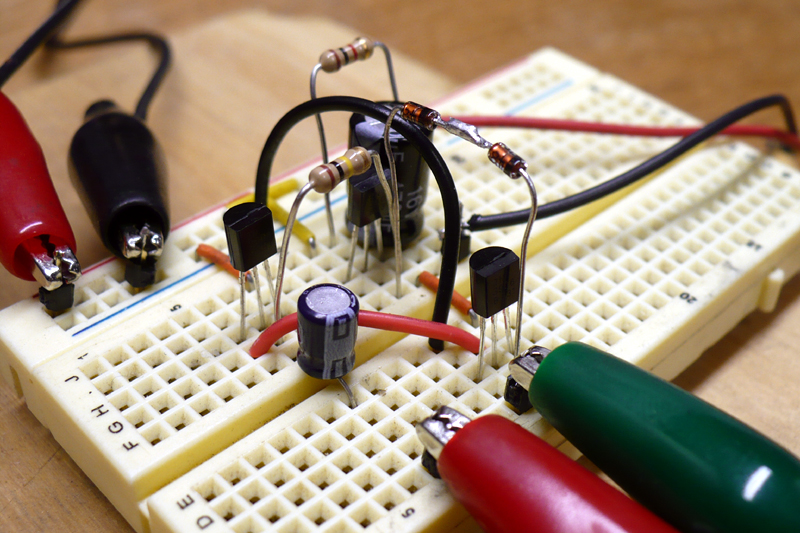
Class AB Audio Amplifier

This week we’ll take a look at another type of audio amplifier, the class AB amp. As we saw in Hack #19 the class A amp has a transistor that is biased with a voltage that makes it essentially stay turned on all the time. This single transistor handles the entire waveform both positive and negative.
The class B amplifier uses two transistors. One handles the positive side of the waveform and the other handles the negative side of the waveform. Each transistor is in an off state until the waveform crosses over the zero point and then it must turn on. This takes about 0.7 volts so there is a small amount of time that the transistor is not amplifying the signal. This lag time at the crossover point can cause distortion. There is a way around this however, the class AB amplifier.
In the class AB amp the transistors are biased in such a way so as to never fully turn off. They are kept on by two biasing diodes which allow a small amount of collector current to flow even when there is no signal present. This means then that the transistor will be “ON” for more than half a cycle of the waveform but much less than a full cycle giving a conduction angle of between 180 to 360o or 50 to 100% of the input signal depending upon the amount of additional biasing used. The amount of diode biasing voltage present at the base terminal of the transistor can be increased in multiples by adding additional diodes in series.
There’s a great tutorial on class AB amps on Electronics-Tutorials.ws. I encourage you to visit this site where you’ll find a wealth of educational information on electronics.

This project is fairly easy to build and all the parts are readily available. You can use just about any NPN and PNP transistors, just make sure they’re within similar specs to each other.

Keep on hackin!

Parts list:

2 – 2N3904 NPN transistors
1 – 2N3906 PNP transistor
1 – 47 uF electrolytic capacitor
1 – 470 uF electrolytic capacitor
1 – 100K ohm resistor
1 – 1K ohm resistor
2 – 1N4148 diodes

Schematic:

Posted in Weekly Hacks | 20 Comments

The Single NPN Transistor Audio Preamp

Here’s a great little project that goes well with the LM386 audio amp. It’s a good first time transistor project because it’s simple and demonstrates the common emitter class A amplifier circuit with only six components in the signal path.

Here’s an excerpt from a great tutorial I found on NPN transistors:
A “Class A Amplifier” operation is one where the transistors Base terminal is biased in such a way as to forward bias the Base-emitter junction. The result is that the transistor is always operating halfway between its cut-off and saturation regions, thereby allowing the transistor amplifier to accurately reproduce the positive and negative halves of any AC input signal superimposed upon this DC biasing voltage. Without this “Bias Voltage” only one half of the input waveform would be amplified. This common emitter amplifier configuration using an NPN transistor has many applications but is commonly used in audio circuits such as pre-amplifier and power amplifier stages.

I powered this circuit with a single 3V coin battery I salvaged from an old computer motherboard. It works just fine at this low voltage because it’s just a preamp. Go build one and keep on hackin!

Parts List:
1 – 2N3904 NPN transistor
2 – 10K resistors
1 – 100 K resistor
1 – 0.1 uF ceramic capacitor
1 – 1 uF ceramic capacitor
1 – 3V – 9V battery and holder

Posted in Weekly Hacks | 23 Comments

The Hexababy Robot

When I dream up hacks I usually think about them for a day or so first. I had an idea this week for another cat toy and I thought I had it pretty well worked out. Once I got into the build though, a mechanical problem reared it’s head which required an entire redesign and brought the project to a screeching halt!

So there I sat on a Friday night with a busy weekend ahead and no project to post… hmmmm.

As I looked around my workbench some things suddenly came together. I had this Spider robot from Hexbug.com that I bought at Radio Shack and a silly doll head that I chopped off from a doll I found at thrift store. Yes, I buy weird stuff from the thrift store. Hey, ya never know when you’ll need some doll parts right? I had already stuck the doll head on the spider one evening when I was at the bench goofing around live on ustream. I figured I needed to do some sort of hack to it though in order to post it up as a project. I decided to add some LEDs to the eyes and one inside the head and feed them the same power that drives the motors in the bot. Since they’re diodes already it would be easy to make the red ones light up in forward and the green one light up in reverse simply by their orientation to the power.

Follow along with the video as the mad scientist in me performs plastic surgery and hacks up a The Hexababy!

Next week we’ll get back to some electronics but until then, keep on hackin!

Posted in Weekly Hacks | 3 Comments

The Murray Riding Mower Restoration

When I started this whole Hack A Week thing I posted an introductory video in which I stated I would be doing all kinds of projects. While most of them have been centered around electronics I have deviated into such things as Chicken Tractors and a workbench build.

This week I decided to share a project I’ve been working on for a few weeks. My landlord gave me a free riding mower a while back that had quit running. It had a list of things wrong with it. It needed a new battery, two tires had gone flat, the charging system didn’t work, the seat was falling off, the drive belts were cracked and most importantly, the engine would no longer start up and run.

Being as the engine is the heart of the machine I decided to tackle this problem first. The most common problem with a mower that won’t start is a dirty carburetor and the easiest way to check the condition inside is to remove the float bowl. It’s usually held on with a single brass bolt which also holds the main jet which meters the fuel. When I removed this one I found a lot of dirt and a faulty float and needle valve assembly. I ordered up the new parts directly from Briggs & Stratton online and received them in a few days time. After installing them on the engine it still wouldn’t run which meant something had failed mechanically. It did indeed crank over as if it had no compression, which meant that something had gone wrong with the valves. Time to pull the valve cover.

After removing the valve cover the problem quickly revealed itself. The rocker arms were both loose and out of alignment with the valves, which meant that the engine could not breath properly. This misalignment had also bent one of the push rods which was easily straightened. After a little tightening and realigning the valve train was back in working order. I re-installed the valve cover and gave it a crank. As you’ll see in the video it fired right up and ran fine! There’s more things that I fixed and I’ve documented them in the video along with the “hack” part of the project which is revealed at the very end.

So get comfy and enjoy 22 minutes of mower restoration… and as always, keep on hackin!

Posted in Weekly Hacks | 2 Comments

The FM Transmitter Bug

Building an FM transmitter is fun! This kit was very easy to build so it would be a good first time kit if you’re just getting started in electronics. If you can understand how to read capacitor and resistor values and you can solder, you can build this kit. If you’d like to build one they can be purchased from these vendors:
http://www.hobbyengineering.com/H1481.html
http://www.hobbytron.com/Mini-FM-transmitter-3-Volt-FM-Transmitter-bug-kit.html.

My Friend John S. gave this kit to me recently and I thought it would be a good Hack A Week project. There’s some good electronics to learn about here: class C amplifiers, FM transmission, VHF antennas, positive and negative feedback, stray capacitance, and induction.

The circuit is basically an audio amplifier that modulates a radio frequency oscillator tuned around 100 MHz. Output from the collector of the amplifier transistor is fed into the base of the second transistor where it modulates the resonant frequency of the “tank” circuit (the 5 turn coil and trim capacitor) by varying the junction capacitance of the transistor. Junction capacitance is a function of the potential difference applied to the base of the transistor. The tank circuit is connected to a Hartley oscillator circuit.

I was able to receive transmissions out to 30 meters and that was going through a metal garage door. The range can be greatly extended by using a dipole antenna rather than the half wave antenna. Connect the dipole to the circuit with a 50 ohm coaxial cable. Connect the center lead to the antenna point on the circuit and the outer shield to earth ground. I’ll be experimenting more with this.

Have fun building this and keep on hackin!

Component list:

Resistors: (carbon, 0.25 W, 5%)
1 – 1Megohm
1 – 47K ohm
1 – 22K ohm
1 – 10K ohm
1 – 470 ohm

Capacitors:
1 – 1n ceramic #102
1 – 5pf ceramic
2 – 22n #223
1 – 27pf ceramic
1- 100n monoblock

Other stuff:
2 – BC547 transistors
1 – 5 turn coil (make sure you separate the windings so they don’t touch each other)
1- Electret microphone
1 – tripcap, yellow (6 – 45 pf)
165 cm antenna wire
Battery holder, 3v – 9v.

Posted in Weekly Hacks | 1 Comment