Mini-Hydroponic Strawberry Farm

Yes, Hydroponics!

This one was inspired by my girlfriends request to help her out with a hydroponics project. She’s an instructor on the Mobile Launch Pad which is run by the North Carolina Community Colleges. They want to make a hydroponics display that had a hands on feel to it, but there was some concern about time and maintenance. This wouldn’t be like a house plant that you could just move wherever you like… or could it?

So I decided to build a mini-Hydroponics, or Aeroponics set up here at home to test out ideas and so I could give them a report as to what it takes to grow plants in water and how portable this might be. After some research and a lot of learning along the way I have come to realize that there’s more than meets the eye when it comes to hydroponics. Since we won’t be using soil, we’ll need some other medium to convey water and nutrients to the plant but how? Soil is easy because it’s where plants just naturally grow. All of the major and minor elements are there ready for the plant to absorb through it’s roots. What if we just put the plant right into water? We would need to add all the nutrients the plant needs to the water.

Water is a bit different everywhere. It can vary in how many dissolved solids are present. Too many dissolved solids in water can quickly become a problem in a small hydroponics setup. The PH of the water is another important factor. It should be between 5.0 and 7.0. Too alkaline (7.0-) and the plant can’t absorb the minor nutrients such as iron. Lack of Iron will show itself as yellowing leaves. Too low (5.0) and the roots can suffer.

This all means that we need a fertilizer that has a good balance of Nitrogen, Phosphorus, and Potassium. These are represented as numbers on the fertilizer labeling. The fertilizer I choose, Jacks Classic, has and even blend of 20-20-20. This means it has 20% Nitrogen, 20% Phosphorus and 20% Potassium. PLUS, it has all the minor nutrients like Copper, Iron, Manganese, Molybdenum and Zinc. The minor nutrients are the ones that usually have to be derived from the soil. Most plant foods like Miracle Grow don’t have enough of the minor elements to work well with hydroponics. The plants will start off fine, but gradually fail due to lack of certain nutrients at different stages of it’s development.

One important thing to take note of. I used a clear plastic tub for this project for visual purposes. Once my setup was complete. I wrapped the entire tub in two layers of black trash bag plastic and taped it in place. This keeps out ambient light which will lead to algae growth in the water. An alternative light blocking method is to find a very dark container or simply spray paint the outside of it all black.

This setup is pretty simple and all the parts and materials are readily available at most hardware stores, pet supply stores and plant nurseries. It is however, EXPERIMENTAL> This is a first attempt at hydroponics and I plan on posting updates on this project so check back often.

Enjoy the video… all he info you need to build this is there.

Keep on hackin!

Posted in Weekly Hacks | Comments Off on Mini-Hydroponic Strawberry Farm

Five Minute Power Window Blinds

As I was wrapping up the stepper motor project last week I opened the window blinds for more light and thought, “hey… it would be cool to just grab a motor and attach it to the window actuator rod in the same way I coupled the stepper motor to the magnet motor. Instant power window blinds!”

So, The camera was already right there and I had the time so I hacked a motor to my window blinds, pretty much as you see it transpiring in the video. I decided to just let images do the talking in this one.

As for the music, I did what I always do, every week with a hack video. I go to freemusicarchive.org where I enter a keyword in the search bar then listen to the selections. This week I typed “motor” and I found the song you’ll hear, “Behave like motor” from Salakapakka Sound System.
So listen now with your eyes and enjoy the video and music.

Keep on hackin…

T – 8

Posted in Weekly Hacks | Comments Off on Five Minute Power Window Blinds

Stepper Motors As Generators

Stepper motors are everywhere! They’re pretty easy to find in old abandoned printers. They come in a variety of configurations and number of poles but they all make great electrical generators! Any electric motor will also output a voltage when it’s freely spinning. Stepper motors are much better at this because they have many times more poles to pass next to each other thus generating electrical pulses.

These pulses are actually AC voltage that can be used to directly drive LEDs. I’ve experimented with different LEDs connected in this way on my bike light stepper generator and none of them have burned out yet. This AC voltage can also be rectified and converted to a DC voltage with the addition of a simple full bridge rectifier explained below.

HOW RECTIFICATION WORKS
Below is a full wave rectifier circuit. The stepper motor produces a sine wave whose polarity (positive or negative) changes sign each half cycle. When the direction of the current is from the generator into the bridge at point c, the only available current path through the bridge is cbad, through the resistor from right to left in the diagram. During the next half cycle, the current direction is from the generator into the bridge at point d. Then the only available path is dbac, but again the current direction is from right to left through the resistor. Therefore the current through the resistor always has the same direction.

_

WAVEFORMS OBSERVED IN THIS CIRCUIT:

AC SINE WAVE

_

RECTIFIED DC HALF WAVE

_

RECTIFIED DC FULL WAVE

_

As shown in the video below, this rectified DC voltage can be very useful as a power source for LED lights or charging small batteries.
This motor had a peak output of 43 volts at .41 mA.

EXPERIMENT!!!!
Stepper motors are awesome hackable items and they’re easy to come by. Think of all the ways you can get a motor to spin from salvaged energy. If something is moving, that motion can be converted into motion of the stepper and used to generate electricity. Wind, water, wheels, drive belts, hand cranks, treadmills. Let your imagination invent a way! I encourage you to try building this experiment platform and then seeing how you can salvage electricity from your environment with a stepper motor!

POST YOUR RESULTS IN THE COMMENTS BELOW!

Keep on hackin!

Posted in Weekly Hacks | 8 Comments

How To Mix A Pan Galactic Gargle Blaster

It’s Hack #42 and in honor of Douglas Adams, author of The Hitchhiker’s Guide to the Galaxy this week’s hack is a how-to about a drink called the Pan Galactic Gargle Blaster!

So what does Hack #42 and Hitchhiker’s Guide have in common? Well it’s the number 42. In the novel, the great computer, Deep Thought was asked the question “what is the answer to life, the universe, and everything?”. After 7.5 million years of computing it came up with the answer. “42” Yes, 42.. that’s it.

So, here we are in the here and now (supposedly) mixing up the Pan Galactic Gargle Blaster!
Watch the video for some fun, then read on for a behind the scenes explanation of how it was done.

Well that was fun!
This project was really a bit of theater with some custom made props. I made up some labels, printed them out and applied them to the bottles with some spray adhesive.

What was actually in the bottles?
Ol’ Janx Spirit – vinegar
Santraginus V Seawater – water with blue food color
Arcturan Mega-Gin – sugar rock candy with yellow food color
Fallian Marsh Gas – air from an inflated balloon
Qualactin Hypermint Extract – Olive Oil
Algolian Suntiger Teeth – Effervescent vitamin C tablet also known by the brand name “Airborne”
Zamphuor – water with yellow food color

The table top was covered in cheese cloth and under it was a layer of baking soda. When the drinks were spilled at the end of the video the vinegar reacted with the baking soda making it bubble and foam up as if it were an acid eating into the table.

I hope all of you Hitchhikers Guide fans out there enjoyed this video as much as we enjoyed making it…
…and to the late great Douglas Adams I’d like to say, “So long and thanks for all the fish!”

Keep on hackin!

Posted in Weekly Hacks | Comments Off on How To Mix A Pan Galactic Gargle Blaster

DIY Guitar Fuzz Effect Box

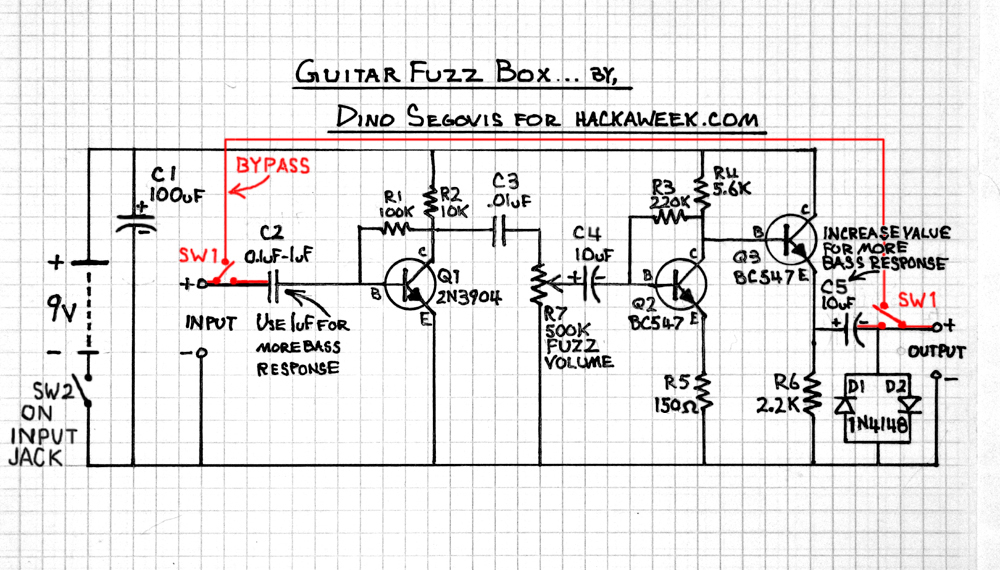
I received a message from a youtube viewer suggesting that I do a “Fuzz Face” guitar effects box as a project.. It seemed like a good idea so after a bit of scouring the interwebs and looking at schematics (there are plenty) I put together a three transistor distortion box that’s not too difficult to put together.

It’s a two stage amp with the first stage boosting the signal and the second stage creating the distortion and clipping. The distortion comes from the two BC547 NPN transistors going into saturation and the clipping is done by the two 1N4148 diodes. Although I didn’t include it in the final build video, a bypass switch can be added as shown in red on the schematic. Use a push on/push off DPDT switch.

The “Fuzz” potentiometer controls the level of the signal from the 2N3904 and as the level is increased, so is the distortion and clipping of the output signal.

Guitar effects boxes are fun to build and experiment with while in the bread board stage. Play around with C2 and C5 values to change the frequency response and gain.

Have fun and…
Keep on hackin!

Parts list:

Capacitors:
1 – 100 uF electrolytic
1 – 1 uF ceramic
1 – .01 uF ceramic
2 – 10 uF electrolytic

Resistors:
1 – 100 K
1 – 10K
1 – 220K
1 – 5.6K
1 – 150 ohm
1 – 2.2K
1 – 500K potentiometer, audio taper

Diodes:
2 – 1N4148

Transistors:
1 – 2N3904 NPN
2 – BC547 NPN

Misc:
1 – Push/Push off DPDT switch
1 – 9 volt battery
1 – 9 volt battery clip
1 – perf board
1 – plastic or metal enclosure
2 – 1/4″ phono jacks, one with a switch that has continuity when a plug is inserted. This will serve as a power switch.

Schematic:

Posted in Weekly Hacks | 3 Comments