Tube Radio Repair

As I was getting the new work shop organized I discovered that my old Zenith AM/FM vacuum tube radio wasn’t working properly. When the tubes warmed up it emitted a 60 cycle hum from the speaker, which is usually a sign of a bad filter capacitor. A filter capacitor is used in conjunction with a rectifier to convert AC voltage to DC voltage. I needed to get inside the radio and start testing capacitors and this was a good reason to use my newly acquired vintage capacitor checker with a “magic eye” tube!

The back of the radio was easy enough to remove because it just presses in with no screws. Of course, I made sure it was unplugged from power before opening it up even though the power cord has a built in interlock so that when the back is removed, the power cord disconnects from the chassis and stays with the back. This was a safety precaution employed by many electronics devices that were intended to be repaired when something inside failed, quite unlike today’s devices that get thrown away. Once inside I found the main filter cap and tested it. It was OK so I moved on to another possible cause which is corrosion of the tube pins and sockets.

I connected a temporary power cord to the chassis for testing while the back was off. Being very careful to NOT touch anything inside directly with my hands while it was on, I used a long screw driver that I held by the plastic handle and lightly tapped the top of each tube. One of them made a “staticy” noise which meant it had a poor connection in it’s socket. I turned the radio off, disconnected power and set about cleaning the tube pins. I pulled each tube one at a time and used some fine sandpaper to clean the pins, then inserted and removed the tube back in it’s socket a few times to help remove any corrosion from the socket.

A good rule of thumb here when working on older tube electronics. The capacitors can hold a lethal charge. If you have both hands inside the unit and accidentally touch both leads, the current can potentially pass through your body and stop your heart! You can discharge the capacitors by placing a 100 K ohm 5 watt resistor across the leads. As another precaution, never reach inside a device with two hands. Always keep one hand behind you. I learned this from a Ham radio mentor as a kid. It’s just good practice when working on electronics.

Once the tubes had been cleaned I powered the radio up and it worked fine again! You can watch the whole process in the video below.
I love the sound of a tube radio and it’s nice to have on while I’m working in the shop. Vacuum tubes have a nice warm sound and in the video you’ll find out why as I give a brief explanation of how they work based on “Thermionic Emission”.
If you decide to repair an old radio, you do so at your own risk. BE CAREFUL OF THOSE CHARGED CAPACITORS!

Keep on hackin…

Posted in Weekly Hacks | 1 Comment

Building Workshop Shelves

I’m getting settled in to my new work space here and this time around I decided to build some good strong shelves for storage. Shelves are great for this because you can easily see and access what you’re looking for. I had two exposed walls to work with so I decided to attach the shelves directly to the walls. This could have been easily done with some metal shelf brackets but I’ve used this method before and found it to be too weak. Over time the shelves begin to slope downward and you end up with things tipping over or sliding off.

To solve this problem, I mounted a ledger board to the wall and held up the outer side of the shelves with notched vertical supports as pictured below.

Here’s the 2″ x 2″ ledger board with the shelf resting on top of it.

This is the notched 2″ x 4″ vertical support holding the outer portion of the shelf.

These worked out great and created 65 square feet of storage area! Follow along with the video now for a step by step how-to and until next time…

keep on hackin!

Posted in Weekly Hacks | Comments Off on Building Workshop Shelves

Vintage Electronics Find

This past weekend I helped a friend go through her now deceased Grandfather’s work shed to help sort things out, and in exchange for my help she said I could keep any old electronics gear I found. Well I found some pretty cool stuff and it was evident that her Grandfather was a Ham radio guy!

Here’s some pictures with brief descriptions of what I found followed by a video with more details and items.

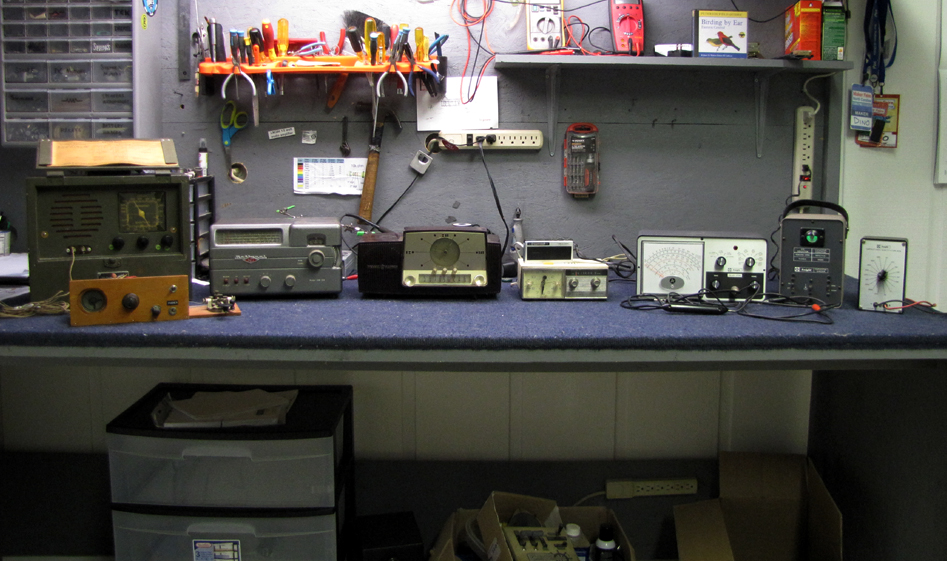
The whole collection on the work bench.

This is a Templetone Radio model # BP 2-A5 from WWII. It ran on batteries and had tubes!This radio picked up “broadcast” band and shortwave transmissions.

This a National Radio SW-54 shortwave receiver from the 50’s and it works just fine.

Here’s a tube operated volt/ohm meter from Allied Electronics. It was made under the name “Knight-Kit”. These kits were marketed to hobbyists and amateur radio operators. This one still works!

Here’s another cool tester from Knight. It’s an in circuit capacitor tester with a “magic eye” tube. I tested it and it works great.

A closeup of the “magic eye”.

And here’s this week’s video showing all this stuff and more! Keep on hackin!

Posted in Weekly Hacks | 3 Comments

Gingerbread Class AB Amplifier

Here it is, just in time for the holidays! A gingerbread circuit based on the same class AB amplifier I made last year for a Hack A Week project. An explanation of the circuit, the schematic and a parts list can be found on that post. This project is about edible gingerbread circuit boards and how to create them.

I used Gingerbread mix for the perf board and capacitors, string cheese for the resistors, candied sugar for the diodes and transistors and licorice whips for the wires. The lettering is white cake writer frosting and the colors are from spray cans of food coloring. The wires are made from hard setting cake icing that has to be heated to be used. When it cools, it becomes solid.

I made molds to cast the diodes and transistors from the molten sugar mixture that was heated to 310 degrees F. When it cooled, it became solid candy!

Everything was measured and scaled up 4.4 times actual size using the metric measuring system. (the english system sucks!)

The Real Thing…

The Gingerbread version…

…and here’s the build video. Hope you enjoy it!
Happy holidays and…
keep on hackin!

Posted in Weekly Hacks | 1 Comment

Fun With Non-Newtonian Oobleck!

Non-Newtonian fluids are strange. They can act like a liquid, or, depending on the force applied, act like a solid. A suspension of corn starch and water is an example of a non-Newtonian fluid that you can experiment with as you’ll see in this week’s video. I used an amplified speaker covered in some plastic wrap to hold the mixture know as “Oobleck” which derives it’s name from the children’s story “Bartholomew and the Oobleck” by Dr. Seuss. The sine wave is generated by my laptop running a free program called True RTA. It’s a real time frequency analyzer available for download. When the sine wave is played through the speaker, strange things happen to the Oobleck and it rises up to dance around!

Have fun with this one and… keep on hackin!

Posted in Weekly Hacks | 2 Comments