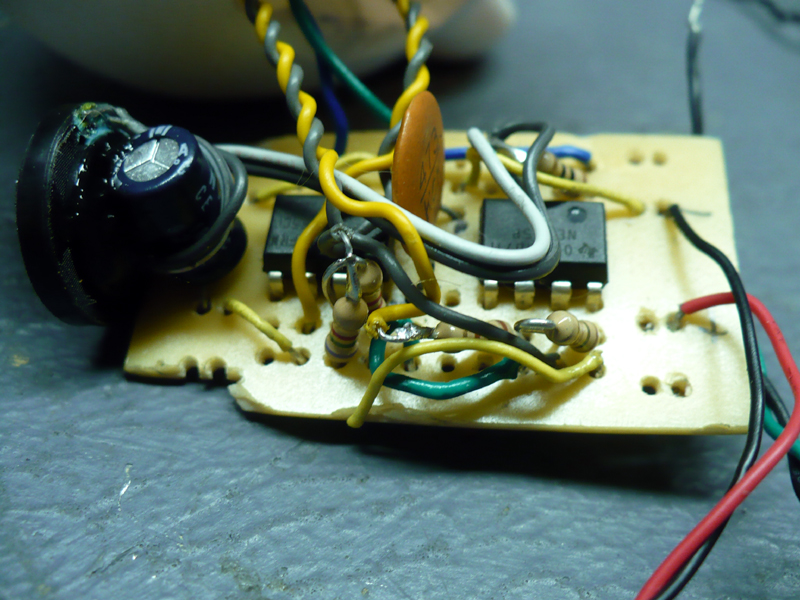
Emic2 Sound To Motion Circuit

Last week I worked on getting familiar with the Emic2 text to speech module connected to and Arduino. This week I’m working on a way to get the mouth of my robot to move in sync with the words that Emic2 is saying. I realize that I could take advantage of the Arduino and write some code that would do just that, but I’d rather find a solution that takes advantage of the audio signal that Emic2 is generating. Since there is a rise and fall in sound signal amplitude, this could translate to a fluctuating voltage connected to a motor. By turning at variable speeds in proportion to the variable voltage of the audio signal, the motor could move a cam that opens and closes the mouth in sync with the words… sort of.
That’s what this circuit does in a sense. The signal enters the circuit through the two small transistors that serve as a switch and an amplifier. When a sound signal is present, the first transistor turns on and allows the second transistor to amplify the sound. This signal then goes to the gate of the MOSFET which in turn switches on and allows current flow across the drain and the source. This current flow can power a motor or servo to open and close the mouth on a robot. As you’ll see in the video, I managed to get a gear motor turning by inputting the sounds from the Emic2.

Next week I’ll tackle the code to generate random phrases. Still working on that one. Arrays? Switch/case? Time to learn more C.

Till next time….

keep on hackin.

Posted in Weekly Hacks | 2 Comments

Intro to the Emic2 Text To Speech Module from Joe Grand and Parallax Electronics.

I was fortunate enough to be a beta tester for the Emic2. I subsequently recieved a second production version of the module. Joe Grand of Grand Idea Studio did a great job designing this very elegant device. At 30mm x 32mm x 10mm and only 6 pins it can snuggle into a tiny space. When it’s connected to a micro controller chip it can give voice to virtually any device… after a bit of hardware hacking. 😉 Joe has a video up of a hack he did on his kid’s toy.

This little gem can be purchased from Parallax Electronics. It comes with a great data sheet that gets into the nuts and bolts of what this module can do.

My girlfriend Lisa came up with a creative way to use two of these modules. She had the vision, I’ll be engineering the project. In this first of three installments, I’ll introduce you to the Emic2 and reveal the “idea” we have. This is going to be FUN!

Keep on Hackin!

Posted in Weekly Hacks | Comments Off on Intro to the Emic2 Text To Speech Module from Joe Grand and Parallax Electronics.

MicroRAX Robot Chassis

The iRobot Roomba is a great robotic device for hardware hackers and robot builders.
They can be found on Ebay for as little as $20 with and without batteries. The battery pack seems to be the main reason they get sold because most users just don’t want to bother replacing the battery, which costs about $45 on Ebay. Other items that cause problems are dirty wheel sensors, a siezed cleaning brush motor and an occasional broken drive belt. Most of these problems aren’t a concern to hardware hackers.

This little four-wheeled robot has been through several changes during it’s life. It started out with a wooden chassis, then aluminum in a couple configurations and now here it is in it’s fourth iteration built with Micro RAX. MicroRAX are made from extruded aluminum and come with fasteners and pre-cut joinery hardware which makes them ideal for robot prototyping. They assemble quickly and accurately and can be easily reconfigured as the design may require. Prototyping is about problem solving and adapting new designs and MicroRAX make this easy!

This bot uses four Roomba motors, a Roomba 400 series mainboard and a Seeduino MCU. The Seeduino sends a PWM signal to the Roomba mainboard H-bridge to control the motors. The pictures below show the four points of motor control on the mainboard PCB. The yellow wire controls forward motion, the grey wire controls reverse motion. There are two H-bridges designed to run two motors, but each H-bridge can easily power two motors at once.

Get the code here: PING_sensor_obstacle_aviodance

Enjoy the build video and KEEP ON HACKIN!!

Posted in Weekly Hacks | Comments Off on MicroRAX Robot Chassis

The Light Controlled Screamer

Before there was Hack A Week, there was DinoFab. dinofab.com was my original website where I posted videos and projects I created. That site will be going offline soon so I’m moving some of it’s content over here to HAW.

This is a fun project to make with the 555 chip. It can be built as a stand alone circuit or you can put it inside a doll, toy or whatever!

Here’s how it works. When it’s turned on, the 555 astable oscillators are activated. One will produce a high pitch squeal through the speaker and the other will blink the LED about twice per second. When you shield the photo cells from light, the frequency of the sound will decrease and the LED will blink slower. If you arrange the photo cells so that they are near the LED, some of the light from the LED will be reflected off whatever is shielding the photo cell. The photo cell will react to the light and raise the frequency while the LED is on, then go back to where it was when the LED is off. See the video below for a demonstration.

I encourage you to try building other circuits with the 555. It’s a very versatile chip with many applications.
Have fun and til next time…

Keep on hackin!

Posted in Weekly Hacks | Comments Off on The Light Controlled Screamer

Hack A Week goes to Maker Faire NC 2012

After a week’s worth of prep involving several late nights and the reconstruction of some projects, Hack A Week made a good showing at Maker Faire NC. The crowd was bigger than last year and the layout was perfect. I had a 20′ x 10′ area to show off eleven projects including the “Fetch-O-Matic” automatic ball launcher which was a huge hit with the kids. They were great beta testers and the thing held up great! Look for a complete build article in the July issue of Make Magazine which will feature the ball launcher on the cover!

Here’s a guy that found my stepper motor generator project of interest…

Of course, I hacked my name badge…

I had two robots there and I used one of them, the PropBot, to hold my cell phone and shoot a robot’s eye view video as it weaved it’s way through the crowd….

… and of course, I posted this video to YouTube last night showing off my stuff and the rest of the entries in the faire.

Keep On Hackin!

Posted in Weekly Hacks | Comments Off on Hack A Week goes to Maker Faire NC 2012